As businesses try to get the best from their training, Scott Christie, Head of Training and Integration at Strengthscope gives an insight into how understanding your individual strengths can help your development.
In the age of AI, every employee is being tasked to learn new skills – whether through redeployment in a new role, or simply to understand how to leverage GenAI to improve efficiency and productivity in their role.
Traditional expectations around learning new skills are that these are gaps to be filled, leading to a perception of starting from scratch, which can feel overwhelming and with the expectation that this will need heavy investment of focus and time in order to be successful – and development is often low on individual’s priority list.
However, this learning can be accelerated by building self-awareness of your internal motivators and energisers – what we at Strengthscope call ‘strengths‘. Our definition of strengths is that these are ‘underlying qualities that energise you and are great at (or have the potential to be great at)’.
The part of the description in brackets is really important, as by playing to strengths, we would have higher developmental ceilings compared to areas where we are not motivated or energised. This is also backed by research showing that learners using strengths when developing skills at work are more likely to achieve:
- learning goals faster and with higher levels of skill acquisition1
- fulfilment of psychological needs and greater sense of well-being2
- enhanced cognitive flexibility, creativity and problem solving3
- higher levels of motivation and can practice more intensely and persistently4
So here are three top tips we would give when looking to use strengths in the arena of skills development:
Encourage skill development in areas of natural strengths
This is particularly important with skills that are role-relevant since levels of persistence and competence are likely to be higher in these areas.
Example a. Strategic mindedness strength: strategic planning, strategic thinking skills
Example b. Efficiency strength: project and programme management skills
Example c. Persuasiveness strength: negotiation and influencing skills
Use strengths to fuel skills development
Encourage employees to select the strengths which will be most beneficial to their learning/skill acquisition, making the links specific, e.g.
I will use my Results focus strength to ensure that I have completed Modules 1-3 by the end of this week
I will use my Collaboration strength to find a learning partner interested in developing skills in the same area as me and we will hold each other accountable for completing learning in this area
I will use my Enthusiasm strength to ‘teach out’ my new learning to my team and encourage them to gain skills in new areas.
Allow individuals to find their own method of learning
Strengths profiles are unique. At Strengthscope we measure 24 strengths and the chances of anyone having the same top 7 rated strengths in the same ranking order as another person is 1 in 1.3 billion. It is the combination of strengths than will fuel learning in each different context with the different outcomes expected. To highlight this, here is some of our own research from our Team Effectiveness in the Workplace 2025 report, which shows the different strengths of leaders in different functions.
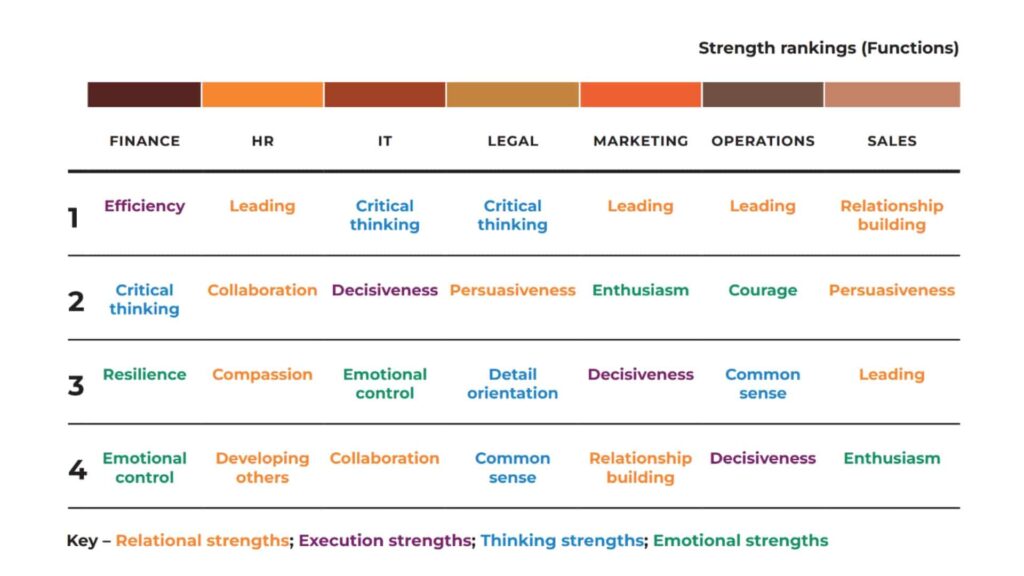
This means it is key that the skills development required may be applied in different ways – so with the awareness and intention use of strengths, the learner will be able to make the right choices on how to maximise their development potential and apply the learning effectively in their role.
1 Moore, Bakker, van Mierlo and van Woerkom (2023)
2 Linley, Nielsen, Wood, Gillett and Biswas-Diener (2010)
3 Fredrickson (2001; 2006)
4 Csikszentmihalyi (1990) and Csikszentmihalyi, Abuhamdeh and Nakamura (2005)