Scott Christie, Head of Training and Integration at Strengthscope on how strengths can be used to redesign and redeploy talent in the age of AI.
“AI is coming to take our jobs.” It’s really not. It has huge potential for all sorts of things, but the most useful aspect is being able to reduce repetitive unthinking tasks and allow us to play at higher levels of cognition in a way to make Abraham Maslow proud.
The fear that removing manual work or finding ways to optimise processes and workflows will mean that specialists will become less, well, special, is a totally understandable fear. After all, I’m sure we all know leaders who fear becoming irrelevant and try to hold on to power for too long, often without changing to fit the new contexts and environmental shifts that happen.
With many organisations continuing to undergo organisational change, there are five key options in terms of developing an effective AI-era workforce:
- Retrain
- Redeploy
- Hire
- Contract
- Release
The bottom three are expensive and resource heavy, especially when you consider timescales around notice periods, gardening leave and onboarding. The top two allow for new opportunities for the existing workforce, but this needs to be positioned effectively so as not to scare good employees away. In a McKinsey survey of company leaders in February 2018, 55 percent of respondents from companies with $1 billion or more in annual revenue said they would laterally move more people into different or brand-new roles than they would release.
Adaptability is consistently high in the most desirable and powerful behaviours / skills for recruitment, and this should include internal recruitment. However, the classic ‘what are my transferrable skills’ fear often means that we can have a narrow view of our options – and this also applies to the business, holding people in specific roles or with a specific view of their potential based on outmoded performance frameworks. However, they may be missing a trick as the best performers don’t just leverage skills, they also use their strengths effectively.
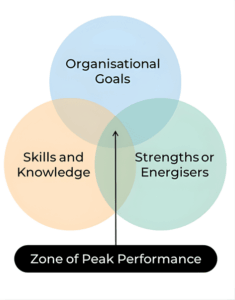
At Strengthscope, our definition of strengths is that these are ‘underlying qualities that energise us and we are great at (or have the potential to be great at)’. These provide us with fulfilment, enjoyment and motivation to perform at our best, and when they overlap with our learned skills and are directed effectively through clear organisation goals, we achieve peak performance.
The helpful thing is that strengths can be termed ‘role agnostic’, meaning that you don’t need to have a specific combination of strengths to succeed in any role. It’s about how you apply them in different combinations based on the context in which you find yourself, providing different strategies to tackle new challenges. This massively plays to the retrain/redeploy strategy, as giving people the chance to play to strengths will lead to higher levels of engagement, empowerment and confidence.
Development levels are also higher – when playing to strengths, there is a higher chance of reaching new levels compared to compliance training, which is a simple pass/fail model. Strengths development is a journey of awareness and leans very effectively into the 70-20-10 model for adult learning through experiential application of strengths on the job. This happens while leaning on the strengths of others to broaden your scope of strengths use (as well as drawing on others where you do not have high levels of energy or motivation) and focusing on context specific learning in areas of strength. This allows development to happen in the flow of work, meaning less focus on off-sites and building trust and knowledge of how to help colleagues be at their best.
As you look at your talent management strategy for the upcoming year, consider leveraging your existing team to achieve great things, allowing them to role craft by playing to their strengths.