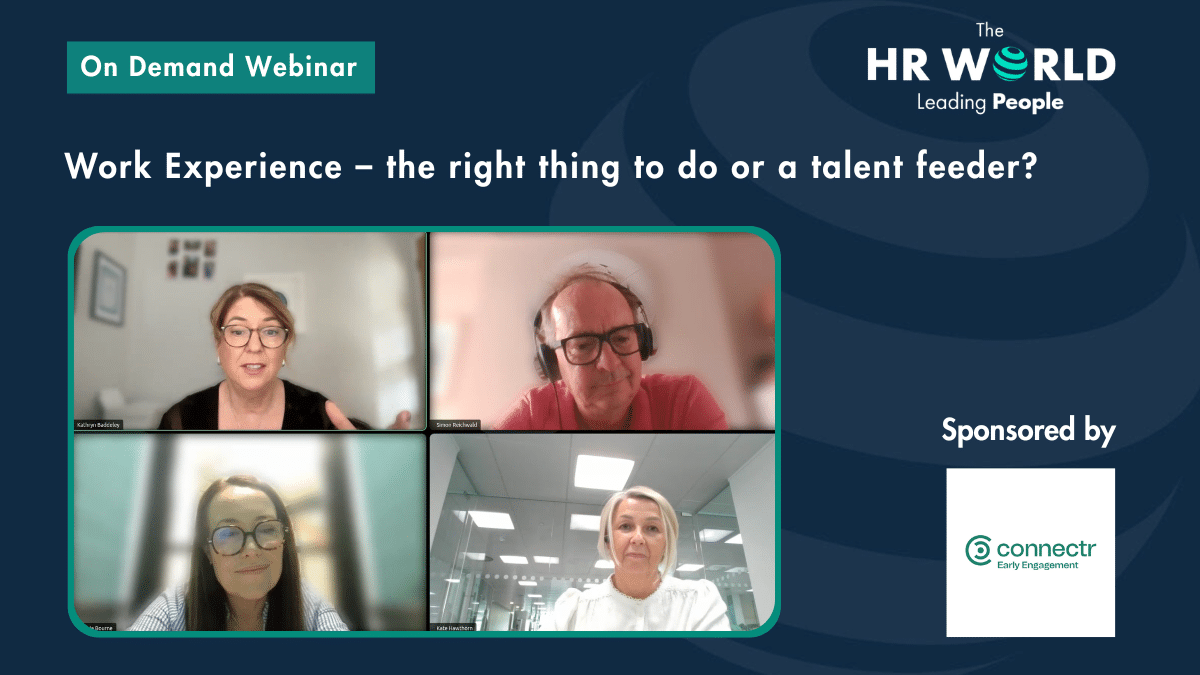
Is work experience the answer to the NEET issue facing the country? And even if it isn’t, are organisations making the most of this model for finding and preparing new and vital talent for the workplace – and for their organisations?
In a webinar from The HR World, sponsored by Connectr, hosted and introduced by Simon Reichwald, Founder, UnTappedTalentUk, these issues were debated and discussed. The panel included Kathryn Baddeley, Head of CSR & Inclusion, Cisco UK & Ireland, Marnie Bourne, Senior Manager, The Careers & Enterprise Company and Kate Hawthorn, Director Consultant Talent, FDM Group. Together they explored how work experience doesn’t just bring benefits for employers and future employees but also how the traditional models of work experience do not meet the current challenges in terms of experience and scale.
The question of opportunity was one that came up early with Simon Riechwald noting that some 81% of young people rely on family and friends to secure work experience. He also explained how Covid and trends such as hybrid working had put additional strain on the traditional work experience model.
The positive elements of work experience were examined by Marnie Bourne who explained how these initiatives fuelled aspiration and essential skills among young people as well as offering a variety of pathways and routes into work. Done correctly, work experience also opens employers to a wider diversity of talent, an aspect that can mean organisations are generating social value through the opportunities they offer.
However, while Kathryn Baddeley explained that her organisation offered a wide range of work experience programmes – from day experiences to week-long hybrid experience which includes working from home – she also said there were barriers to making this work. One of the biggest challenge for her organisation, and indeed for many others was capacity – simply not having the resources to do more.
One answer to this is increasing the flexibility around what work experience actually is. While the traditional model suggests a blocked period of time for teenagers to be in the workplace, there are increasingly more flexible models offering multiple experiences. These can even be 2-3 hour periods for young people to access or day-long sessions rather than requiring a longer commitment. Not only can this be better for employers, it can open opportunities to a more diverse range of students – young people who may not otherwise have been able to access to workplace.
The webinar went on to discuss the creation of Discover Tech. This initiative brought together a wide variety of tech employers and around 300 students for an immersive two day work experience event. On day one the participants took part in sessions on AI, cybersecurity, programming, and digital storytelling while the second day saw smaller groups visiting employers to find out what working in the sector was really like.
By uniting employers into this initiative it was possible to offer a great resource for work experience which excited both students and organisations alike. It gave students a real insight into the word of tech and made the idea of working for these businesses something they could relate to and believe in.
As Kate Hawthorn noted, getting work experience right right now is now less about willingness and more about delivering capacity. From this discussion it is clear that the way ahead lies in creating initiatives that are meaningful and creative, rather than seeking to provide the traditional model.
The panel encouraged employers to think strategically about what they can provide in order to make work experience in the future scalable, inclusive and sustainable.